Showing posts with label ethics. Show all posts

Sunday, November 14, 2010

The Rise of Twitter Imposters

The micro-blogging platform is becoming increasingly popular and with services such as Twitter, the growth has been tremendous. It quickly became a trend and even celebrities – such as Ashton Kutcher and Demi Moore – have created accounts to tweet about their everyday lives. Coyle (2009) states although it is limited to 140 characters, this has not prevented celebrities from revealing a new digital dimension of themselves. However, some believe that the recent surge of celebrities joining this micro-blogging website has also contributed to the growth of celebrity imposters (Schiretta 2009).

Thus, with celebrity imposters and hackers on the rise, followers may have a hard time figuring out whether their accounts are real or fake. When news about the Dalai Lama opening a Twitter account surfaced, many believed this. However, it was a fake account and even before Twitter could do something about it, the account had already gathered about 20,000 followers (Owens 2009). Hence, credibility and authenticity comes into question. This results in users now expressing skepticism whenever an alleged celebrity joins the site (Owens 2009). With that, many have voiced out about the need for some verification system for valid accounts. Biz Stone, the co-founder of Twitter, suggested that providing account verification would be a good way to enhance Twitter since fake accounts are problematic (Coyle 2009).


Twitter's Verified Account badge (source: bloggingtips.com)


Consequently, Twitter now has a Verified Accounts feature which incorporates a seal to show that the accounts have been verified as belonging to the person or organization named (Leyden 2009). This measure is taken to restore faith in the authenticity of celebrity profiles, explains Leyden (2009). With the implementation of this scheme, users can identify real accounts from the fake ones easily compared to before. However, currently this only applies to celebrities and high-profile organizations (Leyden 2009).
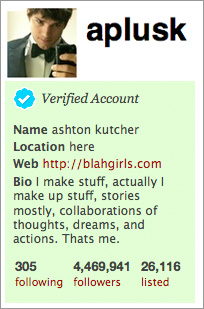

Ashton Kutcher's official Twitter account has the Verified Account badge.

(source: geeksugar.com)


Despite the new system to verify official accounts of celebrities, hackers still manage to hack into celebrity profiles and tweet using their accounts. This proves to be dangerous as newspapers and blogs have begun quoting people on twitter and thus, if nothing is done, it could get ugly (Schiretta 2009). Speaking of ugly situations, there has been a number of celebrities who have gotten their Twitter accounts hacked. According to Constatin (2009), the Twitter account of Disney star, Miley Cyrus, was hacked last year with tweets which read: “I’m not a f****** role model. I hate little kids. I only do Hannah Montana for da $$$$$$”. Several other obscene and offensive messages were posted on her account, with some attacking other stars such as Selena Gomez and Demi Lovato (Constantin 2009). Following the incident, her Twitter account was suspended temporarily by Twitter staff.


Miley Cyrus' Twitter account hacked with offensive tweets (source: allieiswired.com)


Hence, even with the verification seal format, the credibility of Twitter accounts cannot be guaranteed as imposters and hackers still manage to find their way to hack user accounts. Thus, this problem should be further addressed before it causes more harm to society.


References:

Constantin, L 2009, ‘Miley Cyrus’ twitter account hacked’, Softpedia, 18 February, viewed 13 November 2010, <http://news.softpedia.com/news/Miley-Cyrus-039-Twitter-Account-Hacked-104817.shtml>

Coyle, J 2009, ‘Stars (and some impostors) flood twitter’, Huffington Post, 3 March, viewed 13 November 2010, <http://www.huffingtonpost.com/2009/03/03/stars-and-some-imposters-_n_171557.html>

Leyden, J 2009, ‘Twitter fights celeb imposters with verified account scheme’, The Register, 8 June, viewed 13 November 2010, <http://www.theregister.co.uk/2009/06/08/trusted_twitter/>

Owens, S 2009, ‘How celebrity imposters hurt twitter’s credibility’, Media Shift, 20 February, viewed 13 November 2010, <http://www.pbs.org/mediashift/2009/02/how-celebrity-imposters-hurt-twitters-credibility051.html>

Schiretta, P 2009, ‘The growing problem of celebrity imposters on twitter’, Slash Film, 26 March, viewed 13 November 2010, <http://www.slashfilm.com/the-growing-problem-of-celebrity-imposters-on-twitter/>

Think before you type: Social Networking and Micro-blogging Ethics

With social networking and blogging services such as Facebook and Twitter, online publishing and sharing information becomes so quick and easy, it is just a click away. However, many people do not think twice before posting materials on their personal websites. Hence, many cases that occurred in the past decade prove how hazardous and destructive these sites can be, especially to one’s career. Johnson (2010) states that many people turn to the Web for information and news, hence the need for strong ethical practices increases. She lists five ethical principles as follows:

  1. Fiduciary principle – requiring diligence, candor, loyalty to company, disclosure of conflict of interest.
  2. Property principle – requiring respect for others’ property.
  3. Transparency principle – requiring accuracy, truthfulness, and honesty prohibiting fraud, deceit, misrepresentation.
  4. Citizenship principle – requiring civic contribution prohibiting injury/damage to society.
  5. Responsiveness principle – readiness to listen, responding to complaints/suggestions, addressing legitimate concerns of others.

There have been numerous cases where employees have gotten themselves in trouble with their employers due to carelessly publishing materials online (Twist 2004). Perhaps one of the earliest and most prominent incidents was when Delta Airlines flight attendant, Ellen Simonetti, was suspended from her job after posting up inappropriate images of herself in her uniform on her blog, “Diary of a Flight Attendant”. Also known as Queen of Sky in the blogosphere, Simonetti (2004) said the reason she started her blog was as a form of therapy following her mother’s death the previous year. According to BBC news, Simonetti never meant for those pictures to harm the company. However, she was still suspended without warning and has since filed a sex discrimination complaint with the US Equal Employment Opportunity Commission (EEOC). Hence, this issue highlighted concerns about employment law and free speech on personal websites among the blogging community (Twist 2004).

Ellen Simonetti posed in her uniform for her blog (source: connect.in.com)


In another case, a 16 year-old office worker was fired for groaning about her boring job on the social networking site Facebook. Kimberley Swann posted a few comments on her Facebook profile regarding her job, such as, “first day at work. omg (oh my God)!! So dull!!”. Little did she know that three weeks later, those exact words came back to haunt her when her boss discovered them on the net (Levy 2009). Subsequently, she was called to the office and was fired on the spot. The two cases clearly depicted how careers can suffer due to postings on the net. Both Simonetti and Swann were shocked although their images and comments were never intended for their employers to see.

As new media users, we must always be aware that people are constantly listening to what we say. Gerbyshack (2009) reminds us that everything we say online will be captured forever, and this can be re-broadcast across the globe. Hence, we need to abide by the rules and practice ethical publishing. We must also remember that as an employee, we do not have absolute free speech anymore (Twist 2004).


References:

Gerbyshack, P 2009, Fired for facebook and twitter, Philgerbyshack.com, 19 March, viewed 13 November 2010,<http://www.philgerbyshak.com/fired-for-facebook-and-twitter/>

Johnson, J 2001, Is it ethical? Setting company standards for social networking, blogging, and microblogging, Slate Strategy, 29 July, viewed 13 November 2010, <http://www.slatestrategy.com/2010/07/29/is-it-ethical-setting-company-standards-for-social-networking-blogging-and-microblogging/>

Levy, A 2009, ‘Teenage office worker sacked for moaning on Facebook about her ‘totally boring’ job’, Dailymail.co.uk, 26 February, viewed 13 November 2010, <http://www.dailymail.co.uk/news/article-1155971/Teenage-office-worker-sacked-moaning-Facebook-totally-boring-job.html>

Simonetti, E 2004, ‘Perspective: I was fired for blogging’, Cnet News, 16 December, viewed 13 November 2010,<http://news.cnet.com/I-was-fired-for-blogging/2010-1030_3-5490836.html>

Twist, J 2004, ‘Blogger grounded by her airline’, BBC news, 27 October, viewed 13 November 2010,<http://news.bbc.co.uk/2/hi/technology/3955913.stm>

Saturday, November 13, 2010

Journalism Ethics: Objectivity

Will there ever be objectivity in journalism? Fox (2010) states that although objectivity and neutrality have long been the classic principle of journalism, there has been a growing realization that all media organizations are naturally biased, and that the notion of objective reporting is a fallacy. Even among mainstream and alternative media, there is an apparent difference in the angles they approach in its news coverage. Of course, this is due to several factors such as ownership and so forth. Fox (2010) mentions that the inexistence of an objective angle is also because reporters must be selective in choosing one angle, while rejecting the rest.


Objectivity in Journalism (source: editorsweblog.org)


Fernandez (2010) argues that the mainstream media is guilty of embracing corporate orientation since most are owned and controlled by business moguls and bureaucrats. Similarly, mainstream media in the local context are owned by political parties and thus, tend to lean towards one angle in news reporting, which is pro-government. Hence, it will only tell one side of the story while ideas that criticize the government will never be published (Sani 2008). Moreover, mainstream media is used as a platform for political groups to spread their propaganda. Ivan (2007) reveals how these professional journalists attempt to write objectively, but fail at the very mentions of absurd statements, merely in serving the government.

According to Bailey et al. (2008), alternative media is seen to be in a negative relationship with the mainstream media. Thus, its liberal orientation results in a more diverse content, signifying the multiplicity in societal voices. It also offers ideologies and representations which vary from those originating from the mainstream media (Bailey et al. 2008). After all, its main purpose is to deepen social awareness and bring context to certain jurisdiction issues not well weaved by the public (Fernandez 2010). In Malaysia, the internet is poorly controlled; this allows everyone to write whatever they want (Sani 2008). Despite many draconian acts – such as Internal Security Act and the Sedition Act – to control freedom of expression, it cannot be used against someone who merely vents his anger online, so long as there is no foul language or seditious claims that come into play. Sani (2008) also states that alternative media such as Malaysia Kini and Malaysian Today presents topics that not many places offer, and often have ten-fold hits during election periods. He further explains that this indicates the public’s desire to hear both sides of a story.

So, no matter how hard these journalists try to be objective and neutral in news reporting, the public are not that clueless. In fact, Fox (2010) suggests that pure objectivity is technically unachievable as most journalists have agendas – although they do not admit it. Hence, instead of denying, they should proclaim their biases and allegiances so as to win back readers’ trust.


References:

Bailey, OG, Cammaaerts, B & Carpentier, N 2008, Understanding alternative media, McGraw Hill, New York.

Fernandez, YP 2010, General comparison of mainstream and alternative media, Suite101, 1 October, viewed 12 November 2010, <http://www.suite101.com/content/general-comparison-of-mainstream-and-alternative-media-a292116>

Fox, K 2010, What’s your bias?, The Scavenger, viewed 12 November 2010,<http://www.thescavenger.net/media-a-technology/whats-your-media-bias-89546.html>

Ivan 2007, ‘Are there no ethics in Malaysian journalism?’, Malaysiakini, 12 December, viewed 12 November 2010, <http://www.malaysiakini.com/letters/75971>

Sani, I 2008, ‘Mainstream media vs. alternative media’, Ibrahim Sani, 14 March, viewed 12 November 2010,<http://ibrahimsani.com/2008/03/mainstream-media-vs-alternative-media/>